How it works
An image appears: a bar chart, line graph, pie chart, table, map, process diagram or photo. You have 25 seconds to prepare, then 40 seconds to speak. It's scored on content, pronunciation and oral fluency. Content rewards covering the main idea, key details and a conclusion or implication.
A structure that works for any image
- Overview (1 sentence): what the image shows.
- Main point (1–2 sentences): the biggest number, trend or feature.
- Details (2 sentences): a comparison or two with real numbers.
- Conclusion (1 sentence): what it suggests overall.
Use your 25 seconds to find these four things, not to write full sentences.
Useful phrases
| Purpose | Phrases |
|---|---|
| Overview | The bar chart compares… · The line graph shows changes in… between… and… · The diagram illustrates how… |
| Highest / lowest | …was the most common, at… · …accounted for the largest share · …was the lowest, at just… |
| Trends | rose steadily · fell sharply · peaked at… · remained stable · recovered strongly |
| Comparing | …compared with… · roughly twice as many… · whereas… |
| Conclusion | Overall, the data suggests that… · In conclusion, it is clear that… |
Learn the phrases, but don't recite a memorised template with nothing about the image. Pearson says content is checked, and answers that aren't about the image score poorly.
Practice images
Set a timer for 25 seconds, look at an image, then speak for 40 seconds. Better still, use the speaking recorder and choose Describe Image.
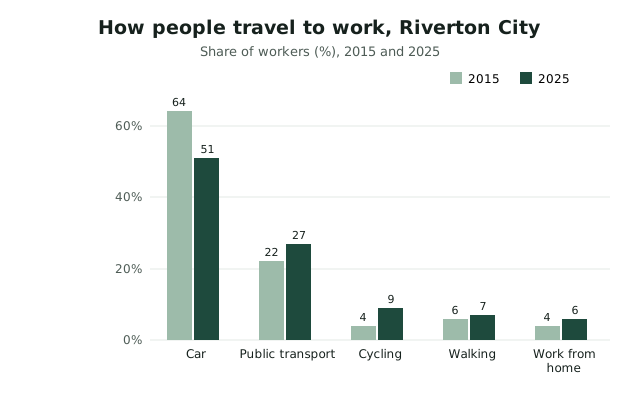
Sample answer for image 1: The bar chart compares how people in Riverton City travelled to work in 2015 and 2025. Driving was the most common choice in both years, but its share fell from 64 to 51 per cent. Meanwhile, public transport rose from 22 to 27 per cent, and cycling more than doubled, from 4 to 9 per cent. Walking and working from home increased slightly. Overall, the data suggests that commuters are gradually moving away from cars towards more sustainable options.

Common mistakes
- Reading every number. Pick the two or three that matter most.
- Stopping early. Aim to speak for 35–40 seconds.
- Long pauses while you think. Use a linking phrase like Looking at the details… to keep going.