Unofficial practice. We wrote these questions to match the official IELTS question types and timings. They are not real exam questions, and points shown are practice feedback, not a band score. For official sample tests, visit ielts.org.
Before you start: use headphones and check your sound with any 🔊 button on the site. The recordings use your browser's built-in voices.
Before you start
Do
- Read the instructions for word limits, like "NO MORE THAN TWO WORDS".
- Skim the passage first, then scan for answers.
- Check spelling: a misspelled answer is marked wrong.
- Leave no blanks. There's no penalty for wrong answers in IELTS.
Don't
- Don't spend too long on one question. Move on and come back.
- Don't write more words than the instructions allow.
- Don't replay the audio. In the real test you hear it once.
How the buttons work
- ▶ Start test starts the clock (35 minutes) and shows one part at a time, as in the real test. In reading, the passage stays on screen next to the questions.
- Move between parts with ◀ Back and Next ▶. As in the real test, you can go back and change answers until time runs out.
- Listening: each recording plays once. Read the questions first, then press play and answer as you listen.
- ❚❚ Pause stops the clock if you're interrupted (the real test can't be paused). End test finishes early and shows your results.
How it's marked
- Multiple-choice, fill-in and listening questions are marked instantly with the real test's rules. See exactly how we mark.
- At the end you'll see a results report by task type, with what to practise next.
Test paused. The clock has stopped.
Loading questions…
Loading questions…
Loading questions…
Loading questions…
How to answer IELTS map labelling questions
- Find the starting point before the recording begins (here, the main entrance) and check where north is.
- Listen for direction language: on your left/right, opposite, just past, beyond, in the north-west corner, at the end of the path, behind.
- The places are described in order, usually as the speaker "walks" you around the map. Follow with your finger.
- Some letters are extra. Not every letter on the map is an answer.
How to answer flow-chart completion
A flow chart follows the steps of a process in order. Before the recording, read each box and predict the kind of word that's missing (a noun? a verb? a machine?). Listen for sequence words: first, next, then, after that, finally. Write words exactly as you hear them, and check spelling: in IELTS, a misspelled answer is wrong.
How the band estimate works
One point per correct answer. IELTS converts the raw score out of 40 to a band using published averages:
| Raw score (Listening) | About band |
|---|---|
| 35 / 40 | 8 |
| 30 / 40 | 7 |
| 23 / 40 | 6 |
| 16 / 40 | 5 |
See IELTS band scores explained.
Answers, explanations and transcripts
Finish the test first, then open each section to check your answers. Every answer has an explanation.
Part 1
Transcript: Part 1: registering for a fun run
Officer: Good afternoon, Coastal Fun Run registrations. How can I help?
Caller: Hi, I'd like to register for the fun run next month.
Officer: Sure. Is that the five-kilometre walk or the ten-kilometre run?
Caller: The ten-kilometre run, please.
Officer: Lovely. Can I take your first name?
Caller: It's Thanh. T-H-A-N-H.
Officer: And your family name?
Caller: Nguyen. N-G-U-Y-E-N.
Officer: Thanks. And your date of birth?
Caller: The ninth of March, nineteen ninety-six.
Officer: Have you done the run before?
Caller: No, this is my first time.
Officer: Great. The entry fee for the ten-kilometre run is thirty-five dollars, which includes a T-shirt. What size would you like?
Caller: Medium, please.
Officer: And are you raising money for a charity this year? Many runners support the children's hospital.
Caller: Actually, I'd like to support the animal shelter, if that's possible.
Officer: Yes, it's one of our three partner charities. Now, for safety, we need an emergency contact. Who should we call?
Caller: My sister, Linh.
Officer: And her mobile number?
Caller: Zero four zero three, seven one two, six eight eight.
Officer: Thank you. The race starts at seven thirty a.m. at the surf club, and we ask runners to arrive forty-five minutes early to collect their race number. There's no parking at the surf club itself, so I'd suggest using the shopping centre car park, which is free on Sundays.
Caller: Perfect. Should I bring anything else?
Officer: Just a water bottle. There are drink stations every two and a half kilometres, but they won't have cups this year, because we're trying to reduce waste.
Answer key (10 answers)
| # | Question | Answer | Why |
|---|---|---|---|
| 1 | Event: ___ | 10 (also accepted: ten) | |
| 2 | km run. First name: Thanh. Family name: ___ | Nguyen | |
| 3 | Date of birth: ___ | 9 March 1996 (also accepted: 9th March 1996, ninth of March 1996, 9/3/1996, March 9 1996) | |
| 4 | Entry fee: $ ___ | 35 (also accepted: thirty-five, thirty five) | |
| 5 | T-shirt size: ___ | medium (also accepted: M) | |
| 6 | Charity: the animal ___ | shelter | |
| 7 | Emergency contact: her ___ | sister | |
| 8 | What time should runners arrive? | B. 6.45 am | The race starts at 7.30 and runners should arrive 45 minutes early: 6.45 am. |
| 9 | Where should runners park? | C. At the shopping centre | 'Using the shopping centre car park, which is free on Sundays.' |
| 10 | What will be different at the drink stations this year? | B. There will be no cups | 'They won't have cups this year, because we're trying to reduce waste.' |
Part 2
Passage text
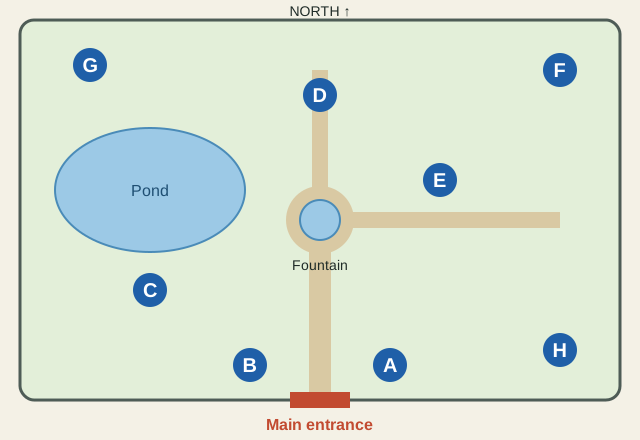
Transcript: Part 2: a tour of community gardens
Guide: Welcome to Greenvale Community Gardens. Before you head off, let me show you where everything is on the map.
Guide: You're standing at the main entrance, at the southern edge of the gardens. As you walk in, the first building immediately on your left is the toilet block. On your right, directly opposite, is the information kiosk, where you can pick up a guide to the plants.
Guide: If you follow the main path straight ahead, you'll reach the fountain in the centre of the gardens. Just past the fountain, on the eastern side, you'll find the café. It has lovely views back towards the fountain, and it's open until four.
Guide: Continuing north from the fountain, right at the end of the main path, is the herb garden, which was planted by local school children.
Guide: Now, if you look to the west, you'll see the pond. On the far side of the pond, in the north-west corner of the gardens, is our greenhouse, which is home to tropical plants. Please note the greenhouse is only open on weekends.
Guide: Families with young children usually head straight for the playground. To get there, go back towards the entrance, but keep going to the far south-east corner of the gardens. You'll see it behind a low fence.
Guide: A few other things. The gardens are run almost entirely by volunteers, about sixty of them, and we're always looking for more, especially on weekday mornings. Dogs are welcome, but they must be kept on a lead. And please don't pick any flowers or vegetables. Produce from the vegetable beds is donated to a local food bank every Friday.
Answer key (10 answers)
| # | Question | Answer | Why |
|---|---|---|---|
| 11 | Look at the map. Which letter shows the location of the toilets? | B | 'As you walk in, the first building immediately on your left': B. |
| 12 | Look at the map. Which letter shows the location of the information kiosk? | A | 'On your right, directly opposite' the toilets: A. |
| 13 | Look at the map. Which letter shows the location of the café? | E | 'Just past the fountain, on the eastern side': E. |
| 14 | Look at the map. Which letter shows the location of the herb garden? | D | 'Continuing north from the fountain, right at the end of the main path': D. |
| 15 | Look at the map. Which letter shows the location of the greenhouse? | G | 'On the far side of the pond, in the north-west corner': G. |
| 16 | Look at the map. Which letter shows the location of the playground? | H | 'The far south-east corner': H. |
| 17 | When is the greenhouse open? | C. Weekends only | 'The greenhouse is only open on weekends.' |
| 18 | The gardens have about ___ | 60 (also accepted: sixty) | |
| 19 | volunteers. Dogs must be kept on a ___ | lead (also accepted: leash) | |
| 20 | Produce is given to a local ___ | food bank |
Part 3
Transcript: Part 3: planning a field trip
Tutor: So, Amira and Josh, you're planning your geography field trip to the river. How's it going?
Amira: Quite well. We've chosen the section of the river near Millbrook, because it's easy to get to by bus and there's a footpath along the bank.
Tutor: Good. What are you going to measure?
Josh: We'll measure the width and depth of the river at five points, and the speed of the water. We also want to take water samples to test for pollution.
Tutor: How will you measure the speed?
Josh: We were going to use a special meter from the department, but they're all booked out that week. So we'll use the traditional method: we'll time how long it takes an orange to float ten metres.
Tutor: That works well. Why an orange?
Amira: Because it floats just below the surface, so the wind doesn't affect it much.
Tutor: Exactly. Now, let's talk about who does what. Amira, what will you be responsible for?
Amira: I'll do the risk assessment, since I've done one before. And I'll take the photographs.
Josh: I'll organise the equipment and book the bus. And I'll write up the results section of the report.
Tutor: And the water testing?
Amira: We'll both do that, because one person needs to collect the samples and the other records the results.
Tutor: Fine. What concerns do you have?
Josh: Mainly the weather. If there's heavy rain the week before, the river could be too high and dangerous.
Tutor: Then you'll need a back-up date. And don't forget to wear boots, not trainers; the bank can be very slippery.
Amira: We'll make sure everyone knows.
Tutor: Lastly, when you analyse the data, compare your results with the figures from the river authority's website. That will make your conclusions much stronger.
Answer key (10 answers)
| # | Question | Answer | Why |
|---|---|---|---|
| 21 | Why did the students choose the river near Millbrook? | B. It is easy to reach and has a footpath | 'Easy to get to by bus and there's a footpath along the bank.' |
| 22 | Why won't they use a meter to measure the water speed? | C. None are available that week | 'They're all booked out that week.' |
| 23 | Why do they use an orange? | B. The wind doesn't affect it much | 'It floats just below the surface, so the wind doesn't affect it much.' |
| 24 | Risk assessment | A. Amira | Amira: 'I'll do the risk assessment.' |
| 25 | Photographs | A. Amira | Amira: 'And I'll take the photographs.' |
| 26 | Booking the bus | B. Josh | Josh: 'I'll organise the equipment and book the bus.' |
| 27 | Water testing | C. Both students | 'We'll both do that.' |
| 28 | Writing the results section | B. Josh | Josh: 'I'll write up the results section.' |
| 29 | What safety advice does the tutor give? | A. Wear boots, not trainers | 'Wear boots, not trainers; the bank can be very slippery.' |
| 30 | What does the tutor suggest for the data analysis? | C. Compare with the river authority's figures | 'Compare your results with the figures from the river authority's website.' |
Part 4
Transcript: Part 4: a lecture on paper recycling
Lecturer: Today I'm going to explain how paper is recycled, a process that saves water and energy, and reduces the amount of waste sent to landfill.
Lecturer: The process begins with collection. Paper from homes and offices is collected and taken to a recycling facility, where it is sorted into different grades. Newspaper, for example, is kept separate from office paper and cardboard, because each grade produces a different quality of product.
Lecturer: Next, the sorted paper is mixed with water and chemicals in a large machine called a pulper. This breaks the paper down into fibres and creates a thick mixture known as pulp.
Lecturer: The pulp is then passed through screens, which remove items such as staples, plastic and glue. After screening, the pulp may go through a process called de-inking. Air is bubbled through the mixture, and the ink sticks to the bubbles, forming a foam that is skimmed off the surface.
Lecturer: If the recycled paper needs to be white, the pulp is then bleached, usually with hydrogen peroxide rather than chlorine, which is more harmful to the environment.
Lecturer: Finally, the clean pulp is sprayed onto a moving belt. Water drains away, and the sheet is pressed between rollers and dried with heated cylinders. The finished paper is wound onto enormous rolls, which can weigh up to twenty tonnes.
Lecturer: It's worth noting that paper can't be recycled forever. Each time it is recycled, the fibres become shorter and weaker. On average, paper fibres can be recycled about five to seven times before they're too short to use, so new fibres from trees must always be added.
Answer key (10 answers)
| # | Question | Answer | Why |
|---|---|---|---|
| 31 | Collection → paper is sorted into different ___ | grades | |
| 32 | → mixed with water and chemicals in a ___ | pulper | |
| 33 | → ___ | screens | |
| 34 | remove staples, plastic and glue → de-inking: ink sticks to air ___ | bubbles | |
| 35 | and forms a foam → bleaching with hydrogen ___ | peroxide | |
| 36 | → pulp sprayed onto a moving ___ | belt | |
| 37 | → pressed between ___ | rollers | |
| 38 | Finished rolls can weigh up to ___ | 20 (also accepted: twenty) | |
| 39 | tonnes. Each time paper is recycled, the fibres get shorter and ___ | weaker | |
| 40 | Fibres can be recycled about five to ___ | 7 (also accepted: seven) |